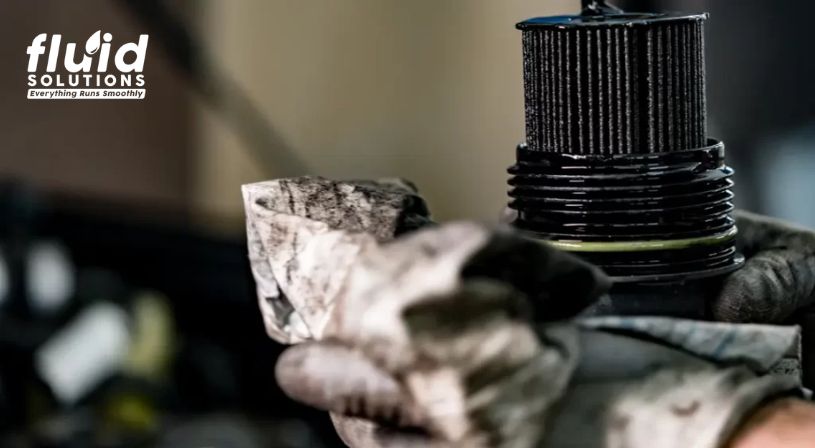
Effective lubrication demands more than quality lubricants. It requires a reliable oil filter paired with an oil filtration system to remove contaminants such as particulates, moisture, and degradation byproducts.
What is Oil Filtration?
Oil filtration is the process of removing internal and external contaminants from lubricants circulating through a machine.
During circulation, oils accumulate:
- Metal wear debris
- Airborne particulates
- Moisture
- Oxidation byproducts
- Varnish and sludge deposits
Unmitigated, these contaminants recirculate incessantly, accelerating components’ wear, corrosion, and oil degradation.
Importance of Oil Filtration
Effective oil filtration system delivers the following benefits:
1. Safeguards Machine Components
Particles of 5–10 microns inflict abrasive wear on pumps, bearings, and valves. Proper oil filtration captures these contaminants upstream, preventing cumulative damage and extending component service life.
2. Boosts Machine Efficiency
Clean oil preserves its lubricity. This minimizes friction losses and viscous drag across moving parts, preserving optimal operating conditions and delivering smoother operation.
3. Prolongs Oil Drain Intervals
Degradation from contaminants shortens oil usability, depleting additives and shifting viscosity. Oil filtration preserves additive performance, maintains stable viscosity, and removes degradation precursors that may help prolong oil drain intervals.
How Oil Filtration Works?
Oil filtration follows this sequence:
1. Reservoir Draw
During operation, oil becomes laden with contaminants and accumulates in the reservoir or return line. The filtration system draws from these points, where the oil remains restorable through downstream filtration processes.
2. Pre-Filtration (or “Coarse Cleaning”)
In this stage, oil passes through a coarse filter that removes heavy debris before reaching finer filtration components. The objectives of this stage are to:
- Remove large debris (approximately 50–100 microns)
- Protect downstream filters from premature loading
This step prevents heavy contaminants from overloading downstream finer filtration elements.
3. Main Filtration (or “Fine Cleaning”)
Main filtration removes smaller particles, often down to 1–10 micron range, depending on system design.
Oil filtration units may also include:
- Depth Filtration Elements: Multi‑layer filter media that capture particles throughout the thickness of the element, providing high dirt‑holding capacity and fine particle removal.
- Water Removal Components: Coalescing or water‑absorbing elements designed to strip free and emulsified water from oil, helping prevent oil contamination.
- Vacuum Dehydration Systems: Oil purification systems use heat and vacuum to remove free, emulsified, and dissolved water, often paired with fine particle filtration to protect equipment.
This stage ensures that the target oil cleanliness level is achieved.
4. Clean Oil Recirculation
Filtered oil is returned to the reservoir or return line. This closed-loop process continuously maintains the target oil cleanliness level throughout the lubricant’s service life.
Optimize Your Oil Filtration with Fluid Solutions
Partner with Fluid Solutions’ lubrication consultants. We integrate high-performance lubricants with proven filtration strategies to achieve target ISO 4406 cleanliness levels and maximize equipment reliability.
Ready to reduce downtime and boost efficiency?
Contact Fluid Solutions today:
Telephone: (+63) 2 8370 5928 | Mobile/Viber: (+63) 917 894 9156
Email: [email protected]
Stay updated on our latest products and technical insights:
Facebook: https://www.facebook.com/fluidsolutionsinc
LinkedIn: https://www.linkedin.com/company/fluid-solutions-inc