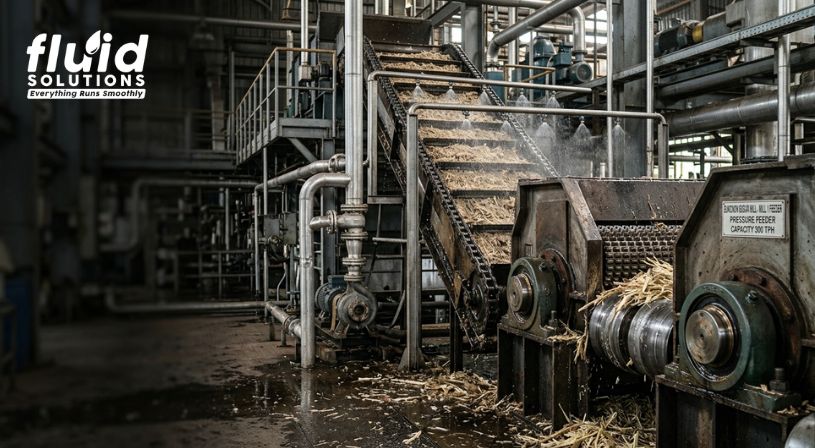
Feeders and imbibition systems close out Phase 1 of the extraction process, and a well-chosen multi-purpose grease often covers most of the lubrication points involved, from pressure feeder bearings to carrier chains and pump bearings. Each of these points sits in a wet, corrosive environment, so water resistance and rust protection matter as much as load capacity.
Key Takeaways
- Pressure feeder bearings require grease with EP protection, water resistance, and corrosion protection to handle heavy sustained loads and constant juice exposure.
- Cane and bagasse carrier chains require a grease or chain lubricant with strong adhesion, water resistance, and anti-wear protection to remain on the chain links during continuous flexing.
- Imbibition water pump bearings require grease with water resistance, corrosion protection, and thermal stability to withstand their constantly wet operating environment.
- Water resistance is critical across the extraction line, as lubrication must withstand continuous moisture, juice exposure, dirt, and fiber accumulation while maintaining protection.
How Feeders and Imbibition Systems Work
Pressure feeders sit ahead of each roller mill and use toothed rollers to grip cane and push it into the mill at a steady, controlled rate. Consistent feed rate matters because uneven loading at the rollers translates directly into shock loads at the bearings and gears downstream, so the feeder’s job is as much about protecting the rest of the tandem as it is about throughput.
Between mills, scraper-elevator chains, commonly called cane or bagasse carriers, move the fibrous residue from one mill to the next. Imbibition systems add water, or juice recovered from a later stage, onto the bagasse ahead of each subsequent pressing, which improves total juice recovery across the tandem. Pumps circulate that imbibition water continuously throughout the shift, and their bearings run in one of the wettest sections of the entire mill house.
Key Lubrication Points
Pressure feeder bearings, carrier chains, and imbibition water pump bearings each face constant moisture exposure, though the load and motion profile at each point differs enough to affect lubricant selection.
| Lubrication Point | Role | Challenging Conditions | Lubricant Type | Recommended Properties |
| Pressure Feeder Bearings | Support toothed rollers gripping and pushing cane into the mill | Heavy sustained loads, fibrous debris ingress, corrosion from juice contact | Grease | • Extreme Pressure (EP) Protection • Water resistance • Corrosion protection |
| Cane and Bagasse Carrier Chains | Move cane and bagasse between mills via scraper-elevator chains | Constant motion and flexing, dirt and fiber accumulation, weather exposure | Grease (chain lubricant) | • Strong adhesion to chain links • Water resistance • Anti-wear protection |
| Imbibition Water Pump Bearings | Support pumps circulating imbibition water onto bagasse | Constant wet environment, corrosion exposure, temperature fluctuation | Grease | • Water resistance • Corrosion protection • Thermal stability |
Read Next: Phase 2, Purification
With Phase 1 now covered, from cane knives through feeders and imbibition systems, the next stage moves into purification. The following article explores how clarifiers, heaters, and evaporators introduce new lubrication considerations, particularly around heat and process-fluid compatibility.
Get in Touch
For guidance on selecting the right multi-purpose grease or water-resistant grease for your sugar mill extraction line, reach out to Fluid Solutions, Inc.
- Telephone: (+63) 2 8370 5928
- Mobile: (+63) 917 894 9156
- Email: [email protected]
Stay updated on our latest products and technical insights:
- Facebook: https://www.facebook.com/fluidsolutionsinc
- LinkedIn: https://www.linkedin.com/company/fluid-solutions-inc
Frequently Asked Questions
Can one multi-purpose grease really cover pressure feeders, carrier chains, and pump bearings?
Often, yes — a well-chosen multi-purpose grease with EP additives and water resistance can cover most of these points. That said, each location has a defining property (corrosion protection at the feeders, adhesion at the chains, dropping point at the pump bearings) worth checking against the specific grease chosen.
What’s the difference between a grease that “resists washout” and one that just “repels water”?
A grease that only repels water on contact can still channel or separate when exposed to sustained flow, losing its protective film right when the bearing needs it most. A washout-resistant grease is formulated to hold its structure under continuous juice or wash-water exposure, not just brief contact.
Why is adhesion the top priority for carrier chain lubricant specifically?
Carrier chains flex continuously and, on many layouts, run exposed to outdoor weather. A grease that clings to the chain links through that repeated flexing stays effective, while a thinner product gets flung off during operation and leaves the chain unprotected.
What is dropping point, and why does it matter for imbibition pump bearings?
Dropping point is the temperature at which grease loses its structure and begins to liquefy. Imbibition pump bearings sit in one of the wettest, most temperature-variable spots in the mill, so a high dropping point grease holds its protective structure even as pump housing temperatures rise during continuous operation.
Why are pressure feeder bearings described as carrying “heavy sustained load” rather than shock load?
Unlike some other extraction components, feeder bearings face constant gripping and pushing pressure against incoming cane rather than intermittent shock. That steady, heavy load — combined with fibrous debris and juice contact — is what drives the emphasis on EP protection and corrosion resistance here.