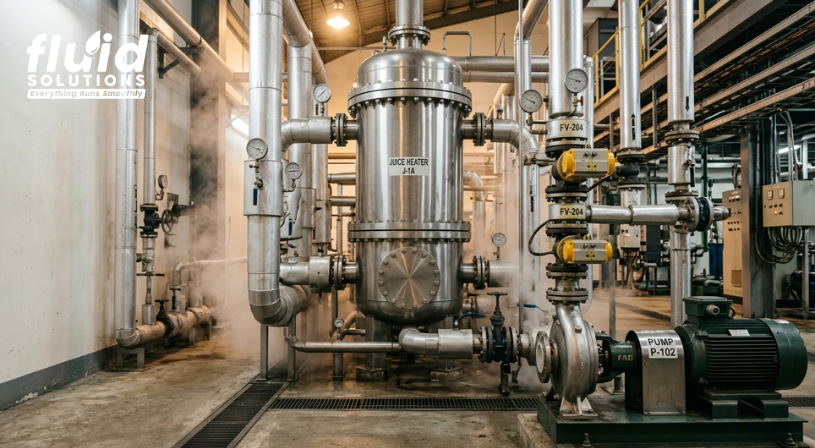
Juice heaters in a sugar mill typically operate between 100°C and 105°C, cycling steam and raw juice through shell-and-tube or plate-and-frame exchangers to raise temperature ahead of clarification. The bearings, valve actuators, and linkages mounted on this equipment run in a mix of condensate, acidic juice residue, and radiant heat, creating demanding conditions for conventional greases.
Key Takeaways
- Juice heaters operate in hot, humid conditions, with juice temperatures reaching 100–105°C before clarification.
- Pump bearing lubrication requires thermal stability, corrosion protection, and water resistance in areas exposed to condensate and juice residue.
- Control valve actuators need a high temperature grease that withstands heat, moisture, frequent cycling, and hardening.
- Condensate and juice residue can promote grease washout and corrosion.
- Base re-lubrication intervals on running hours to match actual equipment use and support consistent machine maintenance.
- Use food-grade lubricants where contamination of exposed juice is possible.
How Juice Heaters Work
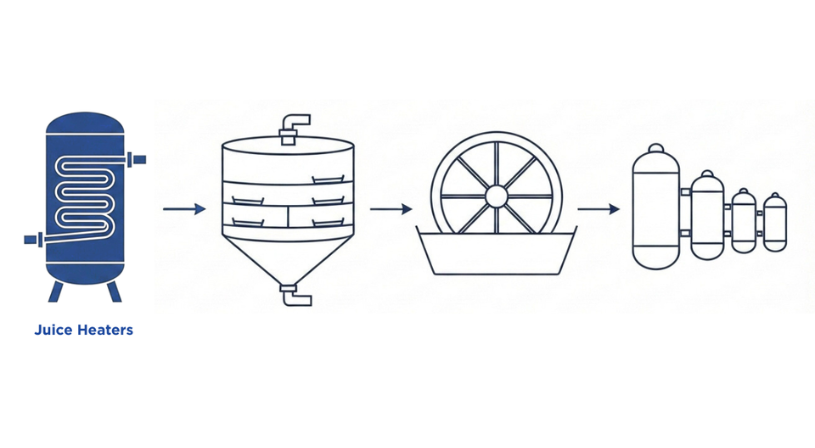
A juice heater raises the temperature of clarified or unclarified juice using low-pressure exhaust steam, usually in two or three stages, to reach the 100–105°C range required for effective clarification. Juice enters through a feed pump, passes through tube bundles or heating plates where steam transfers heat across a metal surface, and exits toward the clarifier or evaporator station.
Two subsystems on this equipment carry the heaviest lubrication demand: the feed pump that maintains consistent juice flow, and the control valve actuators that regulate steam admission to hold target temperature. Both operate in areas exposed to steam leakage, condensate, juice splash, and radiant heat, creating a hot, humid, and corrosive environment. Proper lubricant selection and scheduled servicing help maintain equipment reliability throughout the crushing season.
Key Lubrication Points
The table below summarizes the operating conditions and grease properties relevant to each point.
| Lubrication Point | Operating Conditions | Lubricant Type | Recommended Properties |
| Juice feed pump bearings | Continuous duty, hot juice and condensate exposure, mild acidic/mineral content | Grease | • Thermal stability • Rust & Corrosion protection • Water resistance |
| Control valve actuators | Frequent cycling, steam and heat exposure, humid ambient conditions | Grease | • High-temperature stability • Rust & Corrosion protection • Water resistance • Resistance to hardening |
What’s Next: Clarifiers
Juice heaters set the temperature that makes clarification possible, and the clarifier that follows brings its own set of demanding lubrication points, from rake drive mechanisms to underflow valve actuators. The next article in this series, Lubrication for Sugar Mills, Phase 2: Clarifiers, walks through those requirements in the same level of detail.
Get in Touch
For guidance on selecting food grade grease in the Philippines for your juice house equipment, reach out to Fluid Solutions, Inc.
- Telephone: (+63) 2 8370 5928
- Mobile: (+63) 917 894 9156
- Email: [email protected]
Stay updated on our latest products and technical insights:
- Facebook: https://www.facebook.com/fluidsolutionsinc
- LinkedIn: https://www.linkedin.com/company/fluid-solutions-inc
Frequently Asked Questions
Why does juice mild acidity matter for bearing grease selection?
Juice carries small amounts of acidic and mineral content from the cane. If the grease film breaks down or washes out, that acidity can accelerate corrosion on exposed bearing surfaces. Effective pump bearing lubrication therefore depends on grease with suitable corrosion protection and water resistance.
Why should re-lubrication intervals be based on running hours instead of calendar days?
A juice heater rarely idles during crushing season, so calendar-based scheduling doesn’t reflect actual wear. Basing intervals on running hours keeps relubrication aligned with real operating stress on the bearings and actuators.
What grease properties are important for juice feed pump bearings?
Juice feed pump bearings operate continuously around heat, condensate, and juice residue. Grease should provide good thermal stability, water resistance, and corrosion protection to maintain a reliable lubricant film under these conditions.
Why is water resistance important for juice heater lubrication?
Steam leakage and condensate can collect around lubrication points and gradually wash grease away. A water-resistant grease helps maintain lubrication under wet conditions, reducing the risk of premature wear and corrosion while supporting consistent machine maintenance.