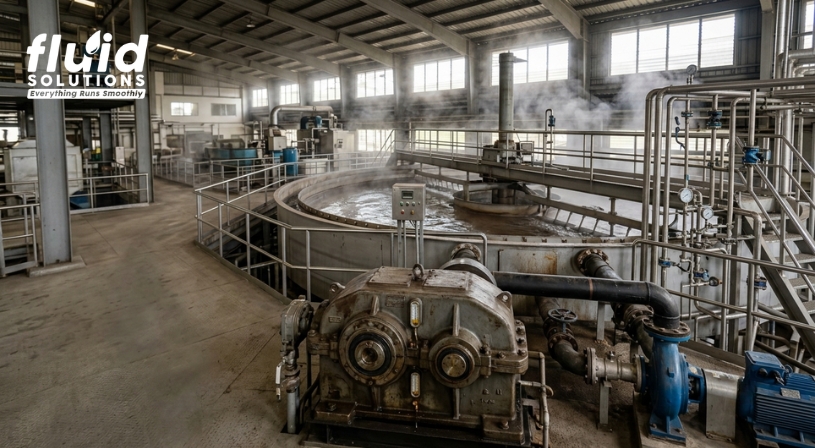
A clarifier tank holds limed and heated juice at 95–100°C for 30–45 minutes, giving mud and impurities time to settle before the clear juice is drawn off for evaporation. Three mechanical systems keep the settling process moving: the central drive shaft that rotates the rake arm, the gearbox that reduces motor speed while multiplying torque, and the pump or valve that clears settled mud from the tank floor. Running continuously throughout the crushing season, all three systems operate in hot, humid, sediment-laden conditions that may shorten lubricant life far more quickly than those encountered in typical industrial applications.
Key Takeaways
- Clarifiers have three main lubrication points: central drive shaft bearings, rake/scraper drive gearbox, and mud discharge valve/pump bearings.
- Drive shaft bearings require greases that can withstand high-temperature and moisture.
- Rake/scraper gearboxes require EP gear oil with thermal stability and water resistance for low-speed, high-torque operation.
- Mud discharge bearings need grease resistant to contamination, abrasion, corrosion, and moisture.
- Regularly sample gearbox oil for water contamination to help maintain gear protection.
How Clarifiers Work
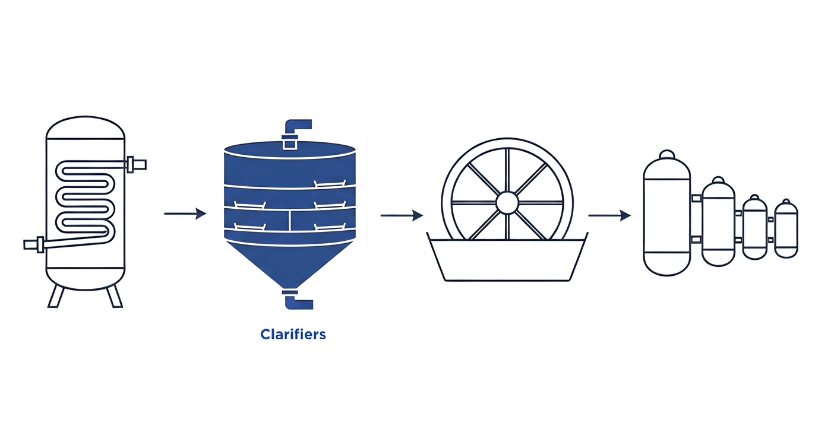
Heated, limed juice enters the clarifier and is held in a large settling tank, where flocculated impurities sink as mud while clarified juice rises and overflows toward the next process step. A slowly rotating rake or scraper arm, driven from a central vertical shaft, moves the settled mud toward a discharge point at the tank base without disturbing the clear juice layer above it.
The mechanism may look plain and straightforward, but the combination of continuous low-speed rotation, high torque demand, and constant exposure to hot vapor and mud makes the drive train one of the more failure-prone systems in the juice house.
Key Lubrication Points
The table below summarizes the three main lubrication points on a typical clarifier and the properties each demands.
| Lubrication Point | Operating Conditions | Lubricant Type | Recommended Properties |
| Central drive shaft bearings | Continuous slow-speed rotation, hot juice vapor, humidity, possible mud contamination at the seal | Grease | • Water Resistance • Rust & Corrosion Protection • High-Temperature Stability |
| Rake/scraper drive gearbox | Continuous low-speed, high-torque operation, heat and humidity | Oil | • Extreme Pressure Protection • Thermal Stability • Rust & Corrosion Protection • Water Resistance |
| Mud discharge valve/pump bearings | Abrasive mud and sediment contact, corrosive process chemicals, cyclical or continuous operation | Grease | • Contamination/Abrasion Resistance • Rust & Corrosion Protection • Water Resistance |
What’s Next: Rotary Vacuum Filters
The mud that leaves the clarifier still carries recoverable juice, and the rotary vacuum filter that processes it next has its own demanding lubrication points, from drum drive bearings to vacuum pump seals. The next article in this series, Lubrication for Sugar Mills, Phase 2: Rotary Vacuum Filters, covers that equipment in the same detail.
If you’re evaluating a grease supplier in the Philippines for your clarifier or gearbox lubrication program, reach out to Fluid Solutions, Inc.
Get in Touch
- Telephone: (+63) 2 8370 5928
- Mobile: (+63) 917 894 9156
- Email: [email protected]
Stay updated on our latest products and technical insights:
- Facebook: https://www.facebook.com/fluidsolutionsinc
- LinkedIn: https://www.linkedin.com/company/fluid-solutions-inc
For additional guidance, here are answers to some common questions mill engineers may have about clarifier lubrication.
Frequently Asked Questions
Why does the gearbox need water separability if it’s not directly exposed to juice or mud? The gearbox sits close to the heat and humidity of the clarifier tank, so periodic condensate ingress is still a risk. An industrial gearbox oil that resists emulsification keeps the EP additive package intact even with that intermittent moisture exposure.
Why check gearbox oil for water content specifically, rather than just visual condition? Even small amounts of moisture accelerate additive depletion in EP formulations, often before any visible change in the oil’s appearance. Scheduled sampling catches that depletion before it compromises gear tooth protection.
Should re-lubrication be scheduled by calendar or by running hours? Running hours. Clarifiers rarely stop once milling begins, so a fixed calendar schedule doesn’t reflect actual operating stress the way running hours do.