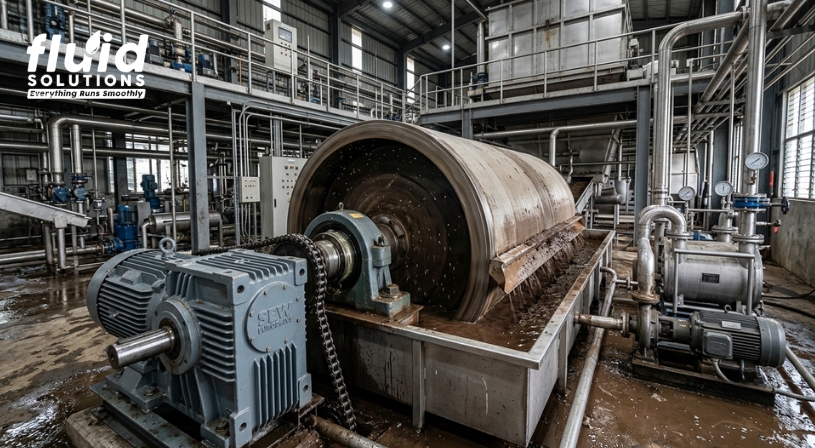
A rotary vacuum filter recovers residual juice from clarifier mud by drawing filtrate through the surface of a rotating drum, typically operating at 1–2 RPM under continuous vacuum. Four components carry the mechanical, and lubrication demands of this process: the worm reducer driving the drum, the trunnion bearings supporting the drum’s weight, the mud pump feeding the trough, and the vacuum pump generating suction.
Running continuously throughout the crushing season, all four components operate in a wet, sediment-heavy environment that accelerates lubricant breakdown and requires closer monitoring than typical industrial applications.
Key Takeaways
- Rotary vacuum filters have four main lubrication points: worm reducer, trunnion bearings, mud pump bearings, and vacuum pump bearings.
- Worm reducers need EP industrial gearbox oil with water resistance and thermal stability for low-speed, high-torque operation.
- Trunnion bearings require water-resistant grease with strong load-carrying and contamination resistance.
- Mud pump bearings need grease that protects against abrasion, corrosion, and water exposure.
- Vacuum pump bearings require water-resistant lubricants with thermal and oxidation stability, depending on pump design.
- Using compatible lubricants and scheduling re-lubrication by running hours can help reduce contamination and unplanned downtime.
How Rotary Vacuum Filters Work
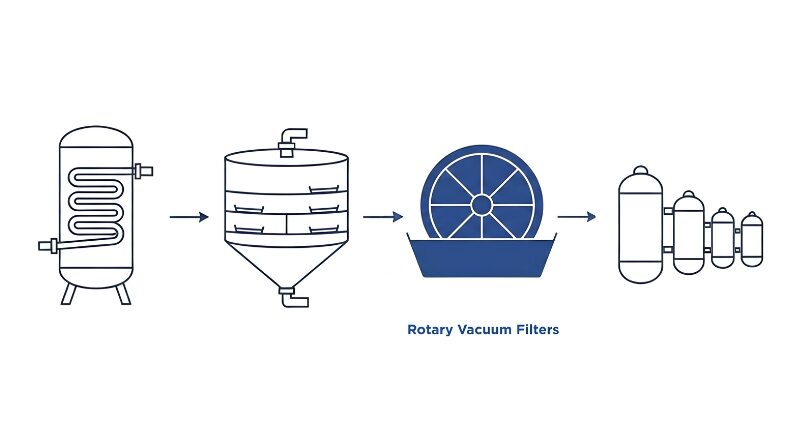
The drum rotates slowly through a trough of clarifier mud, drawing filtrate through a filter medium on its surface using vacuum generated by an external pump, commonly a liquid ring type. As the drum continues rotating, the retained solids (filter cake) are washed, dried under continued vacuum, and eventually scraped off for disposal, while the recovered filtrate returns to the juice stream.
The slow rotation speed is deliberate: it maximizes dwell time under vacuum, so filtrate recovery is as complete as possible before the cake reaches the discharge point. That same slow speed, combined with constant exposure to mud and moisture, is what makes lubrication at this station more demanding than the RPM alone would suggest.
Key Lubrication Points
The table below summarizes operating conditions and lubricant requirements across the four main points on a typical filter installation. These requirements can help guide lubricant selection for the gearbox, pillow block bearing, mud pump bearings, and vacuum pump.
| Lubrication Point | Operating Conditions | Lubricant Type | Recommended Properties |
| Drum drive gearbox / worm reducer | Continuous low-speed, high-torque operation, humid environment, moisture ingress | Oil | • Extreme Pressure Protection • Rust & Corrosion Protection • Water Resistance • Thermal Stability |
| Drum trunnion / pillow block bearings | Mud, filtrate splash, and moisture exposure, heavy load at slow speed | Grease | • Rust & Corrosion Protection • Water Resistance • Contamination/Abrasion • Resistance Load-Carrying Capacity |
| Mud pump bearings | Abrasive, viscous mud, corrosion exposure, continuous operation | Grease | • Abrasion Resistance • Rust & Corrosion Protection • Water Resistance |
| Vacuum pump bearings | Continuous operation, moisture and filtrate carryover, heat buildup | Oil/Grease (design-dependent) | • Rust & Corrosion Protection • Water Resistance Thermal • Stability Oxidation Resistance |
Because each lubrication point faces different combinations of speed, load, moisture, and contamination, lubricant selection should match the requirements of the individual component.
Get in Touch
For guidance on selecting lubricants suited to your equipment and operating conditions, contact Fluid Solutions Inc.:
- Telephone: (+63) 2 8370 5928
- Mobile: (+63) 917 894 9156
- Email: [email protected]
Stay updated on our latest products and technical insights:
- Facebook: https://www.facebook.com/fluidsolutionsinc
- LinkedIn: https://www.linkedin.com/company/fluid-solutions-inc
For additional guidance, the following frequently asked questions address key lubrication considerations for common mill components and equipment.
Frequently Asked Questions
Why does worm gearing need more attention to film strength than other gear types? Worm gearing runs with inherently higher sliding friction than helical or bevel designs. That constant sliding contact, combined with the sustained torque needed to turn the drum against mud trough resistance, raises the demand on the oil’s film strength under boundary lubrication conditions.
Why do trunnion bearings need a stiffer grease than a standard multipurpose product? Trunnion bearings carry the full weight of the rotating drum plus its mud and filtrate load, at slow speed. That combination of heavy static and dynamic load favors a stiffer, higher-consistency grease with reinforced load-carrying additives over a lighter general-purpose grease.
Why is abrasion resistance the top priority for mud pump bearings specifically? The mud pump handles material that is both abrasive and corrosive in roughly equal measure, and bearings here see continuous duty with little tolerance for grease breakdown before contamination reaches the rolling elements — making abrasion resistance the first property to check.
What should mills consider when selecting oil for a vacuum pump? Vacuum pump lubrication requirements vary by pump design and operating conditions. Where lubricating oil is required, factors such as moisture resistance, thermal stability, oxidation resistance, and manufacturer specifications should guide selection. Mills evaluating products from a vacuum pump oil supplier in the Philippines should confirm that the lubricant is suitable for the specific pump design and operating environment.