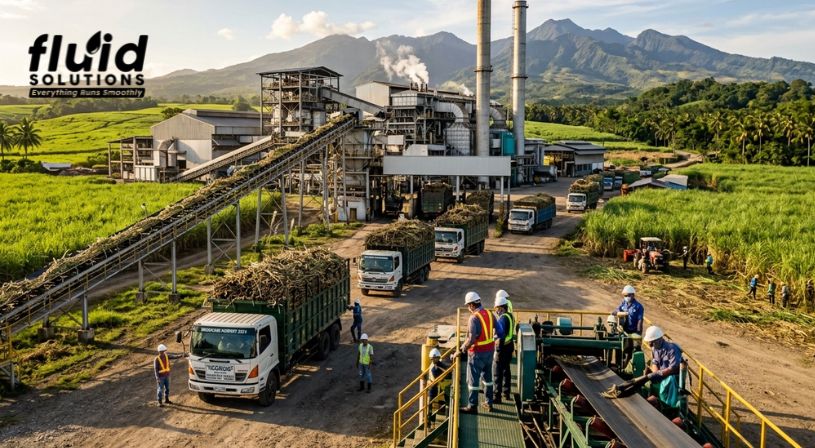
Sugarcane has shaped entire regions of the Philippines for generations, from the fields where it’s grown to the mills where it’s processed. The Philippine sugar milling industry is one of the country’s most significant agricultural sectors, transforming harvested sugarcane into raw and refined sugar, molasses, and other byproducts, all used across food, beverage, and industrial applications.
Mills in Negros, Batangas, and other cane-growing provinces typically operate continuously during milling season, often six to seven months a year, subjecting crushers, gearboxes, and rotating shafts to sustained mechanical stress.
Key Takeaways
- Sugar mills operate under heavy loads, continuous operation, and harsh conditions that place significant demands on industrial lubricants.
- Each stage of the sugar milling process—extraction, purification, and crystallization—uses different machinery with unique lubrication requirements.
- Water, steam, sugar juice, bagasse fibers, and dirt can contaminate lubricants, increasing the risk of equipment wear and unplanned downtime.
- Selecting the right lubricant for each application helps improve equipment reliability, protect critical components, and support efficient mill operations.
The Sugar Milling Process: A Quick Overview
Raw cane becomes sugar through three broad phases, each with a distinct mechanical and lubrication profile.
- Extraction. Cane passes through a series of crushing mills or diffusers that press out the juice, leaving bagasse behind. This phase generates the highest mechanical loads in the entire plant.
- Purification. Raw juice is clarified, heated, and filtered to remove impurities, then concentrated in multiple-effect evaporators before it moves to the boiling house.
- Crystallization and finishing. Concentrated syrup is boiled under vacuum to form sugar crystals, then separated in centrifugal and dried, cooled, and bagged for shipment.
Each phase relies on different sugar mill machinery, and each machine type places different demands on its lubricant.
Why Industrial Lubricants Matter in Sugar Milling
Sugar mill machinery faces harsh conditions such as constant exposure to water, heat, steam, sugar juice, bagasse fibers, and dirt, all of which may contaminate or break down the lubricant over time.
Without sufficient lubricity, these contaminants and conditions can result in seized bearings, overheating gearboxes, worn gear teeth, and scored shaft journals, along with failed crushers, conveyors, or centrifuges. This is why lubrication in sugar mills demands more than routine attention.
What’s Next: A Closer Look at Extraction
The extraction stage deserves its own detailed treatment. Crushing mills, diffusers, and the shafts, gears, and bearings that drive them operate under some of the most demanding conditions in industrial manufacturing. Understanding these machines is the first step toward developing an effective lubrication strategy throughout the extraction process.
Get in Touch
Selecting the right lubricant for sugar mill machinery depends on the specific loads, temperatures, and contamination risks at each stage of the process.
Reach out to our lubrication experts to find the right solution for your mill.
- Telephone: (+63) 2 8370 5928
- Mobile: (+63) 917 894 9156
- Email: [email protected]
Stay updated on our latest products and technical insights:
- Facebook: https://www.facebook.com/fluidsolutionsinc
- LinkedIn: https://www.linkedin.com/company/fluid-solutions-inc
Frequently Asked Questions
Why can’t mills use standard industrial lubricants across all their equipment?
Standard lubricants are typically formulated for dry, cleaner environments. Sugar mills combine water and juice ingress, abrasive fiber, and high heat simultaneously, so lubricants need specific properties like water-washout resistance and thermal stability that general-purpose products often lack.
Which stage of sugar production is hardest on lubricants?
Extraction. Crushing mills and diffusers generate the highest mechanical loads in the plant while also facing constant water exposure, making it the most demanding stage for lubricant performance — and the focus of the next article in this series.