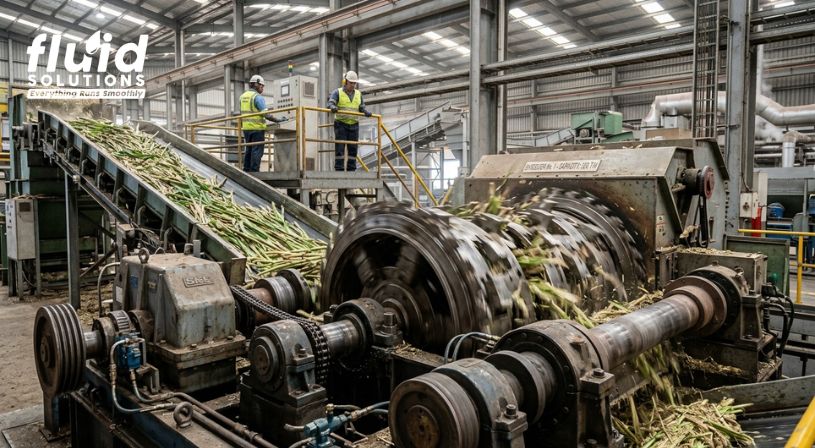
Cane knives and shredders are the first mechanical stage in any sugarcane milling machine, and they run under some of the harshest thermal and contamination conditions in the mill house. Main shaft bearings, drive couplings, and hammer pivot pins each demand a different lubricant profile.
Key Takeaways
- Cane knives and shredders are the first mechanical stage in extraction, running at 500–600 rpm under heavy shock loads from uneven cane feed, tramp metal, and stones.
- Main shaft bearings run hot by design and need high-temperature grease (NLGI 2 starting point) with strong oxidation and contamination resistance.
- Gearboxes and drive couplings need EP-fortified gear oil sized to the manufacturer’s ISO VG, with attention to pour point and demulsibility.
- Hammer pivot pins take repeated impact in a wet, sugar-residue environment, so they need water-resistant grease with EP additives and strong adhesion.
- Each lubrication point — bearings, gearbox/coupling, pivot pins — needs a distinct lubricant; a general-purpose product across all three shortens component life.
How Cane Knives and Shredders Work
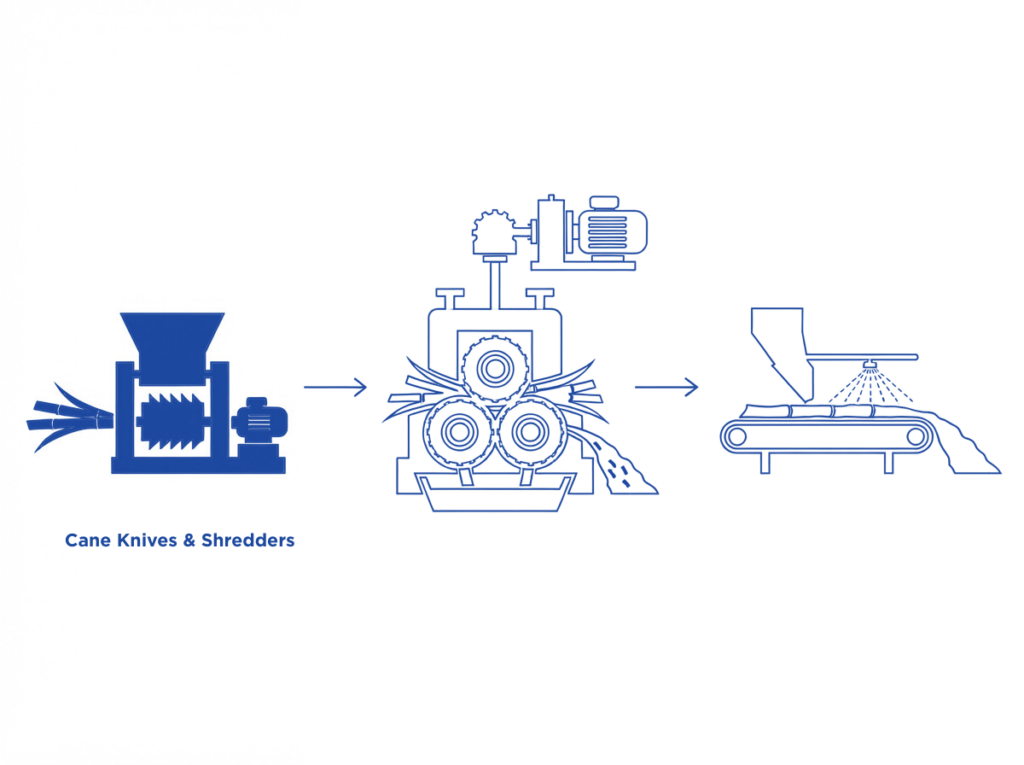
A sugarcane cutting machine typically consists of a set of rotating knives, mounted on a high-speed shaft, which chop whole stalks into shorter billets as they move along the cane carrier. Immediately after, a shredder, often a swing-hammer type unit, tears the billets into a loose, fibrous mat. This preparation stage does not extract juice on its own; it increases the surface area of the cane so the roller mills downstream can press out juice more efficiently.
Both the knife shaft and the shredder rotor turn at high speed, commonly in the range of 500 to 600 rpm depending on mill design and are driven through a gearbox or direct coupling from an electric motor or steam turbine. Uneven cane feed, tramp metal, and stones entering with the cane all introduce shock loads that the bearings, coupling, and pivot points must absorb without losing lubrication films.
Key Lubrication Points
Three components carry most of the mechanical and thermal stress in this stage of the process: the main shaft bearings, the gearbox or drive coupling, and, where swing-hammer shredders are used, the hammer pivot pins. Each has a distinct lubricant requirement.
| Lubrication Point | Role | Challenging Conditions | Lubricant Type | Recommended Properties |
| Main Shaft Bearings | Supports the high-speed rotating shaft driving the knives or hammers | Continuous high-speed rotation, heat buildup, fine fibrous dust infiltration | Grease | • Thermal and oxidation stability • Contamination resistance • Film strength at high speed |
| Gearbox / Drive Coupling | Transmits power from the motor to the cutting or shredding mechanism | Shock load from cane feed variability, sustained heat, moisture ingress | Oil (Gearbox)/Grease (Drive Coupling) | • Extreme Pressure (EP) Protection • Water resistance • Thermal stability |
| Hammer Pivot Pins (For Shredders) | Allow hammers to swing freely on impact with cane | Repeated high-speed impact, moisture and sugar residue exposure, fiber and debris ingress | Grease | • Extreme Pressure (EP) Protection • Water resistance • Resistance to contamination and fiber ingress |
Read Next: Mill Drives and Gearboxes
Once the cane is shredded, the next stage places even greater continuous load on the mill’s drive train. The following article explores how proper gear oil selection, viscosity grading, and re-lubrication practices help protect the reduction gearboxes that power the roller mills.
For guidance on selecting the right high-temperature grease, gear oil, or water-resistant grease for your sugar mill’s extraction line, reach out to Fluid Solutions, Inc.
Get in Touch
- Telephone: (+63) 2 8370 5928
- Mobile: (+63) 917 894 9156
- Email: [email protected]
Stay updated on our latest products and technical insights:
- Facebook: https://www.facebook.com/fluidsolutionsinc
- LinkedIn: https://www.linkedin.com/company/fluid-solutions-inc
Frequently Asked Questions
Why do main shaft bearings on cane knives and shredders need high-temperature grease specifically?
These bearings run hot by design — continuous high-speed rotation generates its own frictional heat, and mill house temperatures during crushing season push bearing housings even higher. Standard grease service limits aren’t rated for that sustained heat, so a high-temperature grease formulated for extended duty is needed.
Why does the gearbox need oil while the bearings and pivot pins need grease?
Gearboxes transmit power through meshing gear teeth, which need a fluid lubricant that can flow into contact points and carry EP additives under shock loading. Bearings and pivot pins, by contrast, benefit from grease’s ability to stay in place and resist washout from moisture and contamination.
What is “mechanical stability under working,” and why does it matter for bearing grease?
It refers to how well a grease resists softening under repeated flexing, measured per ASTM D217. Prioritizing this property over a standard multi-purpose grease helps the grease maintain its protective structure as bagasse dust works its way past seals over time.