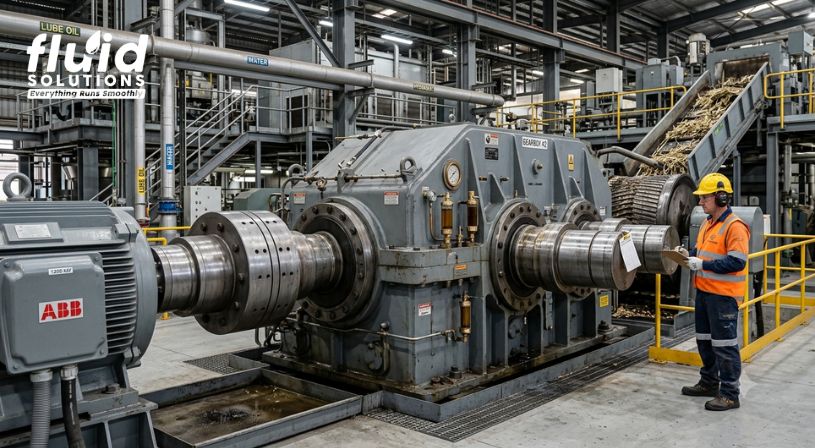
Mill drives and gearboxes carry the highest sustained torque loads anywhere in the extraction line, and gear oil selection at the reduction gearbox has a direct effect on how long that gearbox runs before it needs an overhaul. Turbine or motor bearings, couplings, and the gearbox itself each face a different combination of heat, shock, and contamination, and each calls for a lubricant matched to that specific duty.
Key Takeaways
- Mill drives and gearboxes carry the highest sustained torque loads in the extraction line, running continuously through extended crushing seasons.
- The reduction gearbox needs an extreme pressure gear oil with high viscosity index, thermal stability, and foam resistance to maintain film thickness across a wide temperature range.
- Turbine bearings prioritize demulsibility (water separation) due to steam and condensate exposure, while electric motor bearings prioritize heat and vibration resistance.
- Couplings between the gearbox and roller shaft need high-load-capacity grease with strong adhesion to withstand shock loading from uneven cane feed.
- Relubrication intervals for couplings should be tightened during peak crushing season when shock loading is most frequent.
How Mill Drives and Gearboxes Work
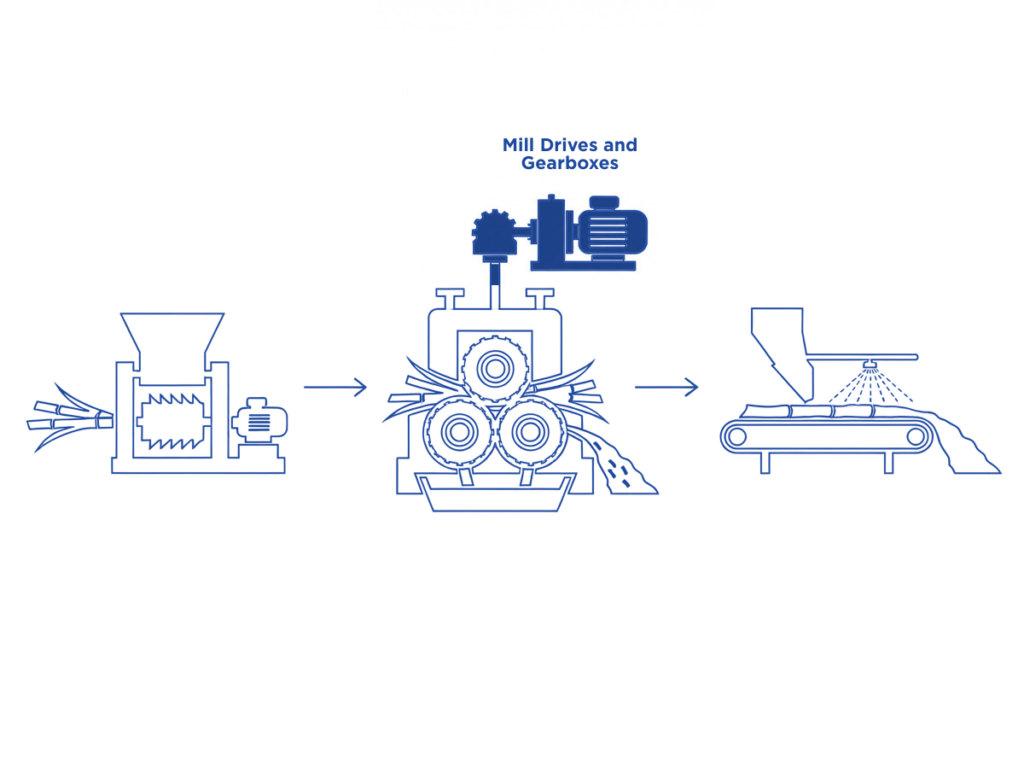
Each roller mill in the tandem is powered by a prime mover, either a steam turbine or an electric motor, which supplies rotational energy at relatively high speed. A reduction gearbox sits between the prime mover and the mill rollers, stepping that speed down while multiplying torque to the level needed to crush cane. From the gearbox output shaft, a coupling transmits torque to the roller shaft itself, often absorbing shock and minor misalignment along the way.
Industrial gearbox maintenance in a sugar mill setting must account for extended crushing seasons where the drive train runs around the clock, with only scheduled stops for cane supply gaps or planned maintenance. Electric motor bearing lubrication and gearbox lubrication both need to hold up under that kind of duty cycle without frequent intervention.
Key Lubrication Points
The reduction gearbox, the turbine or motor bearings, and the couplings each carry distinct loads and each call for a different lubricant category, as summarized below.
| Lubrication Point | Role | Challenging Conditions | Lubricant Type | Recommended Properties |
| Reduction Gearbox | Steps down prime mover speed while multiplying torque to drive the rollers | Continuous heavy torque, heat from power dissipation, contamination from a wet or dusty mill environment | Oil | • High viscosity index • Thermal stability • Extreme Pressure (EP) Protection • Foam resistance |
| Turbine / Motor Bearings | Support the rotating shaft of the prime mover | High rotational speed, sustained heat, vibration, steam and moisture exposure (turbines) | Oil | • Oxidation stability • Strong demulsibility • Rust and corrosion protection |
| Couplings | Transmit torque from the gearbox output shaft to the roller shaft | Shock load from uneven cane feed, slow-speed operation, splash and debris exposure | Grease | • High load-carrying capacity • Strong adhesion • Extreme Pressure (EP) Protection |
Read Next: Roller Mills
Once torque reaches the roller shafts, the actual crushing work begins. The next article explores mill bearing lubrication, crown wheel maintenance, and the heavy-duty greases that help keep the milling tandem operating reliably under continuous heavy loads.
For guidance on selecting the right gear oil, bearing oil, or coupling grease for your mill’s drive train, reach out to Fluid Solutions, Inc.
Get in Touch
- Telephone: (+63) 2 8370 5928
- Mobile: (+63) 917 894 9156
- Email: [email protected]
Stay updated on our latest products and technical insights:
- Facebook: https://www.facebook.com/fluidsolutionsinc
- LinkedIn: https://www.linkedin.com/company/fluid-solutions-inc
Frequently Asked Questions
Why does the reduction gearbox need high viscosity index oil specifically?
Sugar mill gearboxes rarely run at one steady temperature through a full shift. A high viscosity index helps the oil maintain a consistent film thickness across that operating temperature range, which protects gear teeth even as heat builds during continuous operation.
What is demulsibility, and why does it matter most for turbine bearings?
Demulsibility is an oil’s ability to separate from water rather than emulsify with it. Turbine bearings face direct exposure to steam and condensate, so an oil that resists forming a stable water-oil mixture is essential to keeping the lubricating film intact.
How is electric motor bearing lubrication different from turbine bearing lubrication?
Both need oxidation stability and corrosion protection, but turbine bearings prioritize demulsibility because of steam exposure. Electric motor bearings don’t face that steam exposure, so the priority shifts more toward sustained heat and vibration resistance.
Why does foam resistance matter in gearbox oil?
Splash lubrication systems common in older gearbox designs can entrain air during continuous operation. Foaming reduces the oil’s ability to carry load and dissipate heat, which undermines protection even if the base oil’s other properties are sound.
Should coupling relubrication intervals change during crushing season?
Yes. Relubrication intervals should be tightened during peak crushing season, when shock loading from uneven cane feed is most frequent and puts the greatest demand on coupling grease.