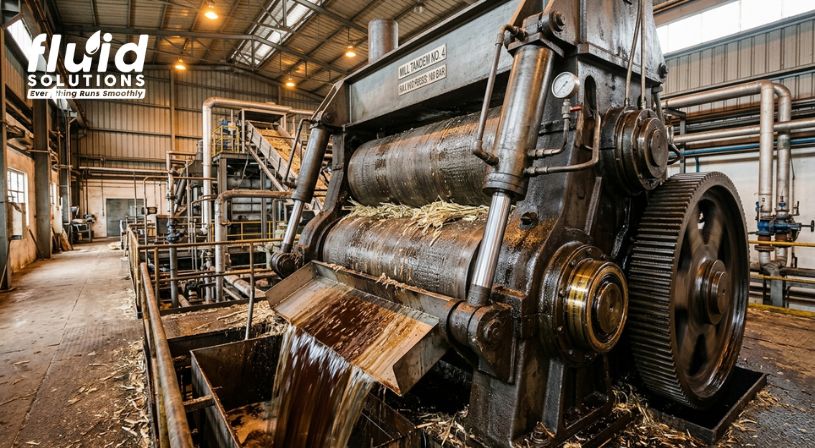
Roller mills are where the actual crushing happens, and three quite different lubricant categories keep the process running: hydraulic fluid controlling top roller pressure, oil protecting the main journal bearings, and grease holding fast to the exposed drive gears. Each point in this system faces a distinct combination of load, contamination, and corrosive exposure from cane juice.
Key Takeaways
- Roller mills rely on three main lubricant types: oil for journal bearings, hydraulic oil for the top roller system, and open gear compound for pinion and crown gears.
- Main roller journal bearings require oil with high load-carrying capacity, strong film strength under shock loading, water resistance, and corrosion protection.
- The hydraulic top roller system requires hydraulic oil with anti-wear protection, oxidation stability, demulsibility, and consistent viscosity under pressure.
- Pinion and crown gears require an open gear compound with strong adhesion, extreme pressure (EP) protection, and water resistance to withstand heavy loads and exposure to juice, water, dust, and fibers.
- Each lubrication point faces different operating conditions and stresses, making it important to match the lubricant to the specific role and environment of the equipment.
How Roller Mills Work
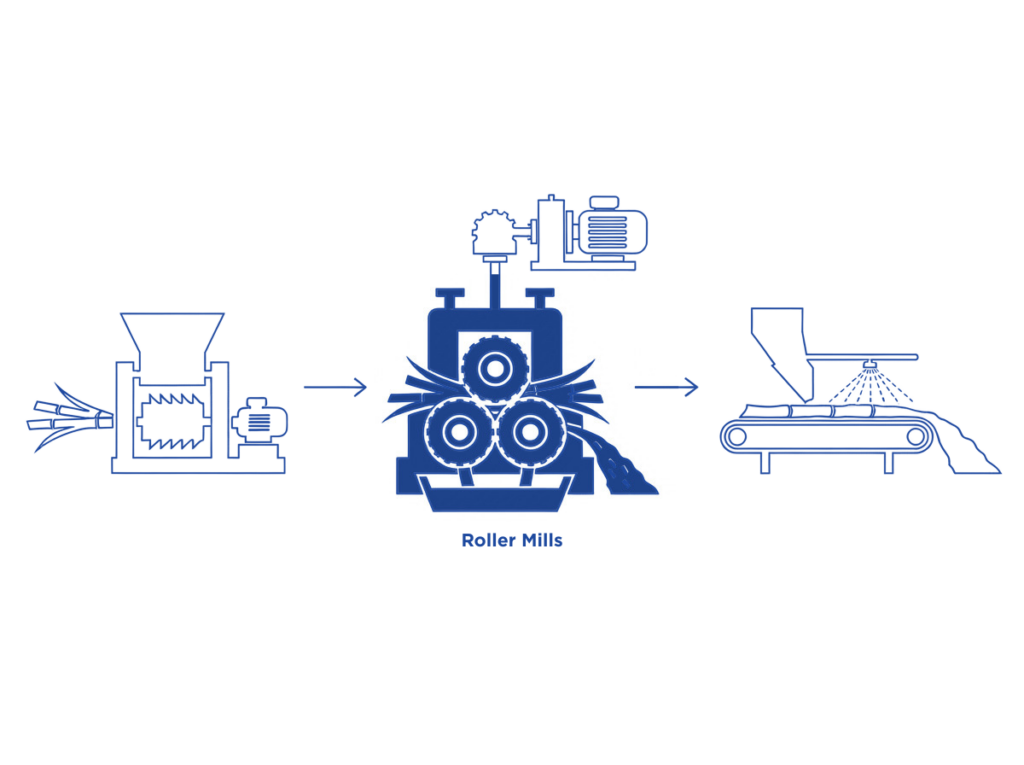
A typical milling tandem in a Philippine sugar mill consists of three to five roller mills arranged in sequence, each with three or four heavy rollers that compress shredded cane to press out juice. Bagasse, the fibrous residue left after pressing, moves from one mill to the next, with each stage extracting added juice from material the earlier mill could not fully press.
The top roller in each mill is not fixed; it floats within the housing and is pushed down onto the cane bed by a hydraulic system, allowing the mill to accommodate variations in bed thickness without losing crushing pressure. Power reaches the rollers through pinion and crown gears connected to the mill drive, and the main rollers themselves turn on heavy journal bearings that carry the full compressive load of the crushing process.
Key Lubrication Points
The main roller bearings, the hydraulic top roller system, and the pinion and crown gears each operate under different stresses, and each needs a lubricant matched to its specific role.
| Lubrication Point | Role | Challenging Conditions | Lubricant Type | Recommended Properties |
| Main Roller (Journal) Bearings | Support the crushing rollers under full compressive load | Shock-loaded pressure from uneven cane feed, continuous juice and water exposure, corrosive contact | Grease | • High load-carrying capacity • Water and cane juice resistance • Corrosion protection • Film strength under shock |
| Hydraulic Top Roller System | Applies and controls pressure pushing the top roller onto the cane | Sustained high pressure, contamination from a wet or dusty environment, temperature fluctuation | Hydraulic oil | • Anti-wear protection • Oxidation stability • Demulsibility • Consistent viscosity under pressure |
| Pinion / Crown Gears | Transmit power from the drive to the crushing rollers | Heavy, slow-speed loads, weather and juice splash on exposed gears, dust and fiber contamination | Grease (open gear compound) | • Strong adhesion • Extreme Pressure (EP) Protection • Water resistance |
What’s Next: A Closer Look at Feeders and Imbibition Systems
With juice extraction underway at the rollers, the next stage focuses on how evenly cane moves through the tandem and how water is added back to improve yield. Understanding feeders and imbibition systems is essential for maintaining efficient operations and ensuring proper lubrication throughout this stage of the process.
Get in Touch
Selecting the right lubricant for your milling equipment depends on the specific loads, temperatures, and operating conditions at each stage of the process.
Reach out to our lubrication experts to find the right solution for your mill.
- Telephone: (+63) 2 8370 5928
- Mobile: (+63) 917 894 9156
- Email: [email protected]
Stay updated on our latest products and technical insights:
- Facebook: https://www.facebook.com/fluidsolutionsinc
- LinkedIn: https://www.linkedin.com/company/fluid-solutions-inc
Frequently Asked Questions
Why do main roller bearings need both high load capacity and shock resistance?
Crushing itself applies extreme, continuous compressive load, but uneven cane bed thickness also creates sudden pressure spikes. An oil chosen only for steady-state load capacity can still break down under those spikes and allow metal-to-metal contact, so film strength under shock load is a separate selection criterion.
What does demulsibility mean for hydraulic oil, and why does it matter in a roller mill?
Demulsibility is an oil’s ability to shed water rather than emulsify with it. Since the mill environment is inherently wet, any water reaching the hydraulic reservoir needs to separate out cleanly, so it doesn’t compromise the oil’s ability to maintain consistent crushing pressure.
What causes sludge and varnish formation in hydraulic systems, and how is it prevented?
Sustained high-pressure operation tends to produce sludge and varnish over time. An anti-wear hydraulic oil with strong oxidation stability resists this formation, helping maintain consistent cylinder response.