Every item on a grocery shelf carries a quiet expectation of safety and cleanliness. Countless systems work behind the scenes to uphold that expectation. Yet these systems are never perfect and always carry an irreducible level of risk. With food, one prevalent risk is contamination.
Among these unseen contaminants are MOSH, MOAH, and POSH, little-known compounds that rarely attract public attention but are an increasing focus of food safety discussions.
What Are MOSH and MOAH?
MOSH (Mineral Oil Saturated Hydrocarbons) and MOAH (Mineral Oil Aromatic Hydrocarbons) are two classes of hydrocarbon compounds derived from mineral oil. Together they form mineral oil hydrocarbons (MOH), a broader group of petroleum-derived contaminants.
MOSH — Mineral Oil Saturated Hydrocarbons
MOSH is a group of petroleum-based compounds formed during crude oil refining. When ingested, MOSH can accumulate in the liver, lymphoid tissues, and spleen, and may cause adverse effects after long-term exposure.
MOAH — Mineral Oil Aromatic Hydrocarbons
MOAH is a group of petroleum-based compounds that include aromatic structures; some variants are potentially genotoxic and carcinogenic (they can damage DNA and are linked to cancer risk). For this reason, MOAH is considered substantially more hazardous than MOSH.
The European Food Safety Authority (EFSA) has raised serious concerns about MOAH, noting that certain fractions cannot be considered safe at any level of dietary exposure. Scientific studies have also confirmed MOSH accumulation in human tissues, although the long-term health consequences are still under evaluation.
What Is POSH?
POSH (polyolefin oligomeric saturated hydrocarbons) are mineral oil-related compounds that originate from synthetic polyolefin plastics, especially polyethylene (PE) and polypropylene (PP). POSH is chemically similar to MOSH and can accumulate in human tissue in a similar way. Until proven further by studies, POSH is generally managed under the precautionary principle and receives regulatory attention similar to MOSH.
How Do MOSH, MOAH, and POSH Enter Food?
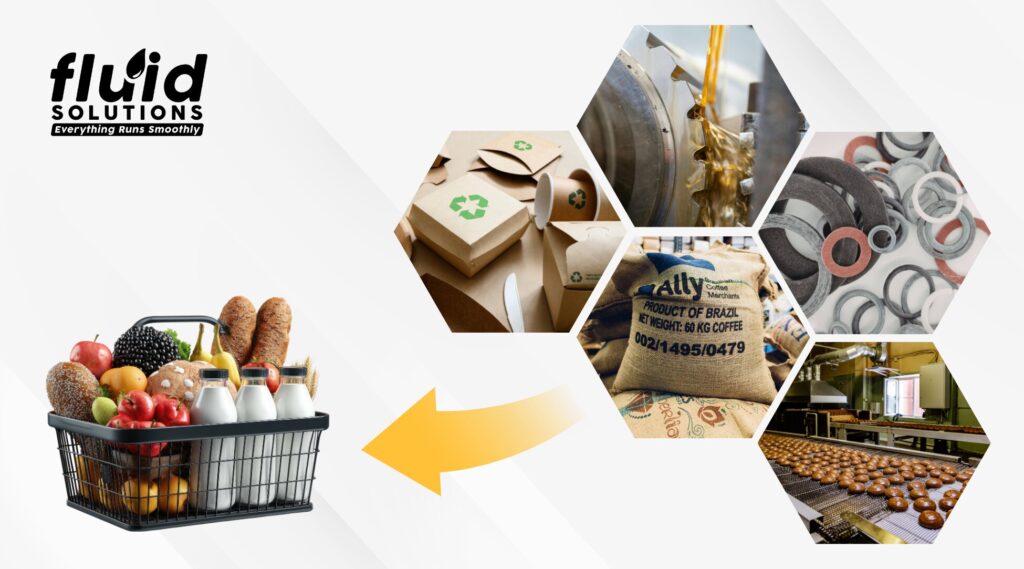
Contamination can occur at multiple points across the food supply chain. Primary entry routes include:
- Packaging Materials
Recycled paper and cardboard, along with printing inks and adhesives, are major sources of MOSH and MOAH. These components can migrate into dry foods such as cereals, rice, pasta, flour, and noodles, especially during prolonged storage. - Process Lubricants and Machine Oils
In food manufacturing plants, industrial mineral oil-based lubricants used near product zones can contaminate food via leaks, spray, or mist. Even food‑grade (NSF H1) lubricants can contribute to MOSH levels if over‑applied, misapplied, or chosen without regard for low‑MOSH/MOAH formulations. - Jute and Natural-Fiber Sacks
Commodities stored or transported in mineral oil–treated jute or other natural‑fiber sacks can absorb MOSH and MOAH; over time these oils migrate into the food matrix, raising MOSH/MOAH levels in raw materials before processing. - Polyolefin Plastics
Polyethylene and polypropylene used for conveyor belts, gaskets, seals, pipes, and containers can release POSH into food, especially at elevated temperatures, with prolonged contact, and in fatty products. - Environment
Airborne mineral oil hydrocarbons from machinery exhausts, compressor oils, fryers, and other industrial sources can settle on exposed foods and on food‑contact surfaces in production and storage areas.
Actions against MOSH, MOAH, and POSH
Regulation and guidance on MOSH, MOAH, and POSH have tightened in response to demonstrated contamination routes. As the evidence base grows, regulators are moving from advisory guidance toward enforceable controls.
In the European Union
The EU is moving to set legal limits for allowable levels of MOAH in food, focusing on the most relevant MOAH molecules (the C10–C50 range). The proposed rules set different limits based on a food’s fat content because MOAH migrates and builds up more easily in fatty foods.
- 0.5 mg/kg for dry foods with ≤4% fat
- 1.0 mg/kg for foods with >4–≤50% fat
- 2.0 mg/kg for fats and oils (>50% fat)
Market products exceeding these levels in official controls are treated as non‑compliant and may pose withdrawal or recall.
For MOSH, EU regulators favor harmonized monitoring with product‑specific indicative levels instead of a single binding limit. Existing guidance sets investigation thresholds that vary by food category, generally in the 1–30 mg/kg range.
POSH are usually detected within the MOSH analytical fraction and are managed under food‑contact material legislation that limits polymer migration and oligomer contamination.
In Germany
Germany’s Federal Institute for Risk Assessment (BfR) has published guidance on MOSH and MOAH and recommends reducing contamination at its source through appropriate packaging, materials, and manufacturing controls.
In Codex Alimentarius
The Codex Alimentarius Commission, the international food standards system established by the Food and Agriculture Organization (FAO) and the World Health Organization (WHO), continues to evaluate MOSH and MOAH within its programme on chemical contaminants in food, contributing to the development of international guidance used by member countries.
However, globally, regulatory approaches to MOSH, MOAH, and POSH are not yet fully harmonised across jurisdictions. While some regions have introduced specific limits or values, others do not currently have dedicated thresholds for these substances and instead address them under general food safety or contaminant regulations.
What This Means for Food Processors and Lubricant Users
In practice, many facilities do not move until they have to. If the risk feels low, or if the chance of getting flagged seems remote, contamination control often gets pushed down the list. But once audits, customer demands, or compliance checks enter the picture, the need for clear controls becomes harder to ignore.
For food-related operations, key actions include:
- Use lubricants intended for food-industry applications where incidental contact is possible.
- Ask lubricant suppliers for clear product information on MOSH, MOAH, and POSH risk. MOSH-, MOAH-, and POSH-free lubricants are also available in the market when the application or requirement calls for them.
- Check packaging, inks, and recycled materials if they are part of the exposure path.
- Apply testing when it supports compliance, customer requirements, or risk management.
That is where lubricant selection matters more. In food-related operations, lubricant choice is part of the wider framework of contamination control and compliance. The next article turns to MOSH-, MOAH-, and POSH-free lubricants and their place in food-industry use.
Reduce Contamination Risk Across Your Plant
MOSH, MOAH, and POSH are residual contaminants that can penetrate the supply chain through packaging, industrial lubricants, plastics, and processing equipment, making effective control of these substances a key responsibility for food manufacturers.
Fluid Solutions has a portfolio of food-grade MOSH-, MOAH-, POSH-free lubricants for various equipment and operational conditions. For reliable industrial lubrication solutions across the Philippines, get in touch with us today:
Contact Us
- Telephone: (+63) 2 8370 5928
- Mobile: (+63) 917 894 9156
- Email: [email protected]
Keep up with our latest products, industry updates, and technical insights: