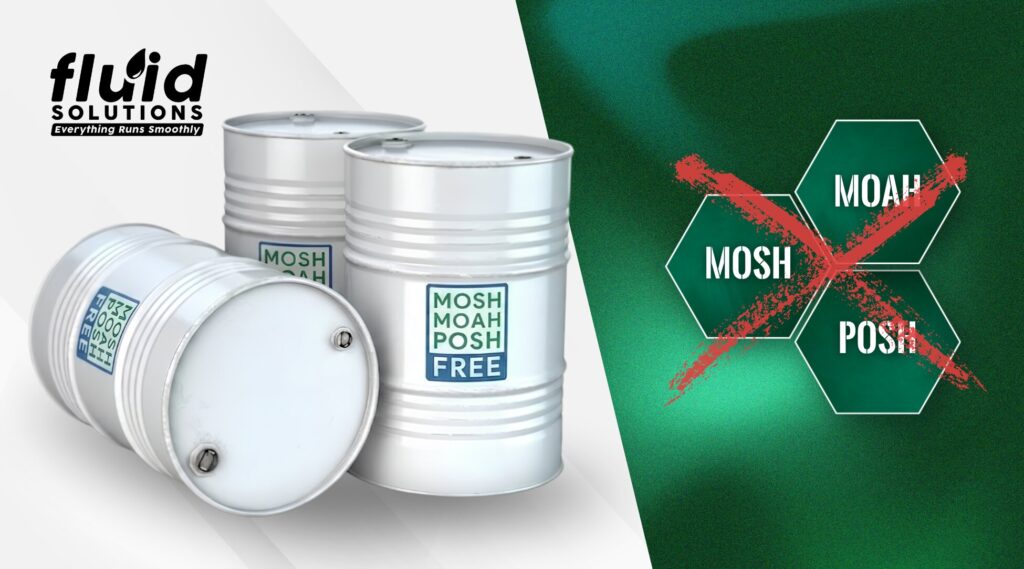
MOSH, MOAH, and POSH are groups of mineral oil hydrocarbons under scrutiny due to the fact that few of its variants may be toxic or carcinogenic. Food and beverage processors are increasingly demanding lubricants that not only support machine components but also minimize the potential risk of mineral oil hydrocarbon contamination.
Building on the previous article “What are MOSH, MOAH, and POSH?”, this piece delves on MOSH‑, MOAH‑, and POSH‑free lubricants and why that designation matters for food safety and regulatory compliance.
MOSH-, MOAH-, and POSH-Free Lubricants Explained
MOSH-, MOAH-, and POSH-free lubricants are groups of machine oils and greases that have been formulated and independently verified to have no detectable levels of:
- MOSH (Mineral Oil Saturated Hydrocarbons)
- MOAH (Mineral Oil Aromatic Hydrocarbons)
- POSH (Polyolefin Oligomeric Saturated Hydrocarbons)
These are the three primary hydrocarbon contaminant groups that regulatory bodies, particularly in the European Union, have flagged as food safety concerns.
How Are They Different from Food-Grade Lubricants?
Food-grade lubricants are formulated for use in food-processing environments and, when certified as NSF H1, are approved for incidental food contact. They are manufactured using ingredients that comply with applicable food-contact regulations and are designed to minimize food safety risks.
However, food-grade does not automatically mean free from MOSH, MOAH, or POSH.
Many conventional NSF H1 lubricants rely on highly refined white mineral oils as their base fluid. Although modern refining processes remove the vast majority of undesirable compounds, trace levels of mineral oil hydrocarbons may still be present. As regulatory scrutiny of MOSH and MOAH continues to increase, even these residual levels are attracting greater attention from food manufacturers and compliance teams.
MOSH-, MOAH-, and POSH-free lubricants represent the next step beyond traditional food-grade formulations. Rather than using mineral oil-based formulas, MOSH-, MOAH-, and POSH-Free Lubricants are typically formulated with synthetic or renewable base stocks, including:
- Polyalphaolefins (PAOs)
- Synthetic esters
- Polyalkylene glycols (PAGs)
- Bio-derived base oils
In addition, additive packages are carefully selected to avoid ingredients that could introduce mineral oil hydrocarbons (MOSH/MOAH) or polyolefin oligomeric saturated hydrocarbons (POSH) into the formulation.
The result is a lubricant designed not only to meet food-grade requirements but also to support evolving industry expectations regarding hydrocarbon contamination, regulatory compliance, and food safety assurance.
Importance of MOSH-, MOAH-, and POSH-Free Lubricants

1. Lubricant Risk Elimination
Eliminating MOSH, MOAH, and POSH at the formulation stage significantly reduces one of the hidden sources of hydrocarbon contamination in food and pharmaceutical production environments.
Contamination is not limited to direct lubricant contact with food products. It can also occur through indirect pathways such as:
- Aerosol or mist formation in high-speed machinery near open product lines
- Vapour transfer in high-temperature processing environments
- Physical transfer via chains, conveyors, and guides that come into contact with food packaging
This highlights why specifying MOSH-, MOAH-, and POSH-free lubricants is critical in reducing indirect contamination routes and protecting both the product and the broader production environment.
2. Regulatory and Audit Readiness
Regulatory bodies are progressively tightening MOSH, MOAH, and POSH thresholds, making the use of mineral oil-based lubricants a growing compliance risk in food environments. Using MOSH-, MOAH-, and POSH-free lubricants helps processors remain audit-ready and reduces the risk of non-compliance.
3. Lubricating Performance
Importantly, these formulations are still engineered to perform as effective lubricants. Modern synthetic and bio-based base oils provide strong lubrication performance, oxidation stability, and equipment protection, ensuring that food safety compliance does not come at the expense of operational efficiency.
For a detailed explanation of testing methods and why they matter, see the follow-up article, “How Are MOSH-, MOAH-, and POSH-Free Lubricants Tested?“. It explores the analytical techniques used to detect these compounds and the documentation manufacturers should provide to support compliance claims.
Make the Switch to MOSH-, MOAH-, and POSH-Free Lubricants
As regulatory expectations continue to evolve, Fluid Solutions supports the transition to MOSH-, MOAH-, and POSH-free lubrication practices. Our portfolio of high-performance oils and greases includes MOSH-, MOAH-, and POSH-Free Lubricants, and is designed for the demands of stringent food and beverage processing environments.
For trusted industrial lubrication solutions in the Philippines, contact us today:
Contact Us
- Telephone: (+63) 2 8370 5928
- Mobile: (+63) 917 894 9156
- Email: [email protected]
Get the latest updates on our products, innovations, and technical insights: