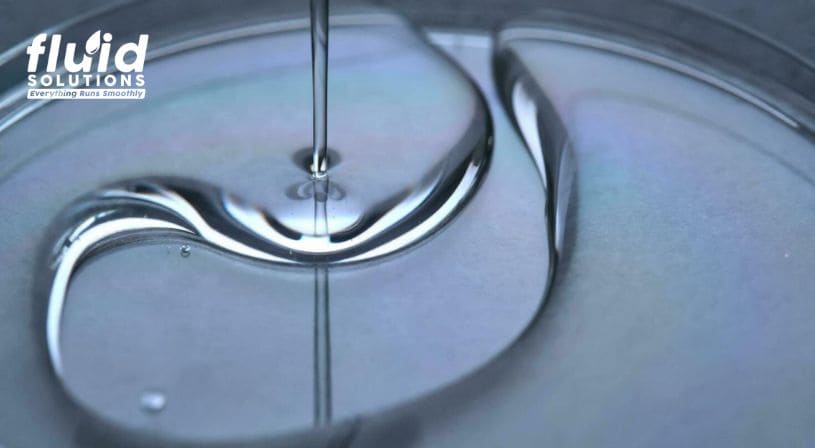
Silicone oils are synthetic fluids, primarily polydimethylsiloxane (PDMS), formulated for superior thermal stability and chemical inertness across extreme temperatures. Their formulation offers low surface tension, high compressibility, and excellent dielectric properties, outperforming many conventional lubricants in high-heat or clean environments.
Classified as synthetic silicone fluids (often API Group V), these lubricants excel in non-lubrication roles like insulation and release agents, with service life extended up to 5 times longer than mineral oils in similar applications. This article examines their composition, advantages, limitations, and common industrial applications.
Composition of Silicone Oil-Based Lubricants
- Silicone Base Oil (90-99%): Derived from dimethylsiloxane monomers polymerized into clear, linear silicone fluids with precise viscosity grades from 5 cSt (low-viscosity release agents) to 1,000 cSt (high-temperature damping variants). This structure avoids hydrocarbons, providing inherent oxidation resistance without wax or impurities.
- Typical Additives Blended (1-10%):
- Anti-foam agents for minimal entrained air
- Specialty inhibitors for moisture or chemical resistance
- Minimal anti-wear additives due to base oil limitations
- Thickeners (silica or lithium complexes) for greases
Key Strengths
Silicone oils shine in extreme temperature and clean-room settings, surpassing mineral-based options in thermal range and inertness.
- Viscosity Index (Effective): >200, enabling consistent flow from -60°C cold starts to 250°C+ operations.
- Thermal/Oxidative Stability: 10,000+ hours of service life, far exceeding mineral oils in harsh conditions.
- Volatility: <1% evaporation loss (ASTM D972 at 150°C), cutting refill frequency by 80% versus mineral oils.
- Pour Point: -50°C to -80°C, ensuring reliable startups in cryogenic applications.
- Low Surface Tension/Water Repellence: Spreads easily to wet surfaces, providing superior water repellence and release properties.
- Dielectric Strength/Low Toxicity: >40 kV insulation with FDA-compliant safety for electrical and food/pharma uses.
| Characteristic | Silicone Oil-Based Lubricants | Mineral-Based Lubricants |
| Viscosity Index (Effective) | >200 | 90-110 |
| Thermal/Oxidative Stability | 10,000+ hours | 1,000-2,000 hours |
| Volatility | <1% evaporation loss | 15-30% evaporation loss |
| Pour Point | -50°C to -80°C | -20°C to -40°C |
| Surface Tension/Water Repellence | Excellent/20-25 mN/m | Poor/>30 mN/m |
| Dielectric Strength/Low Toxicity | >40 kV/FDA-compliant | Moderate/Not suitable |
Key Limitations
Silicone oil-based lubricants have notable drawbacks despite their strengths, often limiting them to specialized uses.
- Costlier: 3-5x more expensive than mineral oil-based lubricants, though longevity might offset total yield cost.
- Poor Additive Solubility: Rejects polar additives like ZDDP/esters; might be incompatible with top-ups with mineral formulations.
- Seal Swelling Issues: Expands nitrile elastomer seals; requires fluorosilicone seals.
- Weak Lubricity: Insufficient film strength for high-load, metal-to-metal contacts; might be incompatible for sliding gears/bearings.
- Moisture Sensitivity: Absorbs water in humid environments (>60% RH), reducing viscosity and stability over time.
Applications of Silicone Oil-Based Lubricants

- High-Temperature Oils: Maintain fluidity in ovens, kilns, and heat-transfer systems up to 250°C without breakdown.
- Dielectric Fluids: Insulate transformers, switches, and cables with high breakdown voltage (>40 kV) and fire resistance.
- Release Agents: Provide mold release in plastics, rubber, and food processing without residue or staining.
- Compressor and Vacuum Pump Oils: Prevent deposits in rotary vane pumps and offer chemical resistance in lab/pharma environments.
- Precision Bearings and Dampers: Low evaporation supports high-speed, low-torque bearings in optics and aerospace.
- O-Ring/Seal Lubricants: Extend life in static seals for plumbing, hydraulics, and cryogenic valves with non-swelling compatibility.
Fluid Solutions’ Expertise in Silicone-Based Lubrication
Fluid Solutions knows a lot about silicone-based lubricants and can help you pick the best silicone oils and high-temperature greases for your business. Our team teaches businesses about the best ways to use silicone lubricants, as well as their properties and performance limits, so that machines can keep running even when things get tough.
We give advice based on the specific application, tailoring solutions for important pieces of equipment like compressors, bearings, heat transfer systems, and more. Fluid Solutions also works in very tough conditions. We help industries keep their equipment running smoothly, reduce wear and tear, and make it last longer by using the right silicone-based lubrication methods and getting technical help when they need it.
Call (02) 8370 5928, 0917 894 9156, or send an email to [email protected] to work with us.
More updates and information are available on our Facebook and LinkedIn pages:
Facebook: https://www.facebook.com/fluidsolutionsinc
LinkedIn: https://www.linkedin.com/company/fluid-solutions-inc